Quick answer: Horse racing odds show how much you win compared with your stake. Fractional odds of 5/2 mean you win £5 for every £2 you bet, so £10 returns £35 including your stake. Decimal odds show the total return per £1, so 5/2 is 3.50. Shorter odds mean the horse is more likely to win but pays less.
This guide explains how to read horse racing odds, how fractional and decimal odds compare, how bookmakers set and move their prices, and what terms like SP, odds-on and Rule 4 mean. There’s a conversion table and an odds calculator to work out your returns.
How do horse racing odds work?
Horse racing odds tell you two things: how much a winning bet pays, and how likely the bookmaker thinks the horse is to win. In the UK and Ireland odds are usually shown as fractions. The first number is what you win and the second is what you stake. At 5/2 you win £5 for every £2 bet, and you get your stake back as well.
The bigger the first number compared with the second, the longer the odds. Longer odds pay more, but the horse is less likely to win.
Fractional vs decimal odds
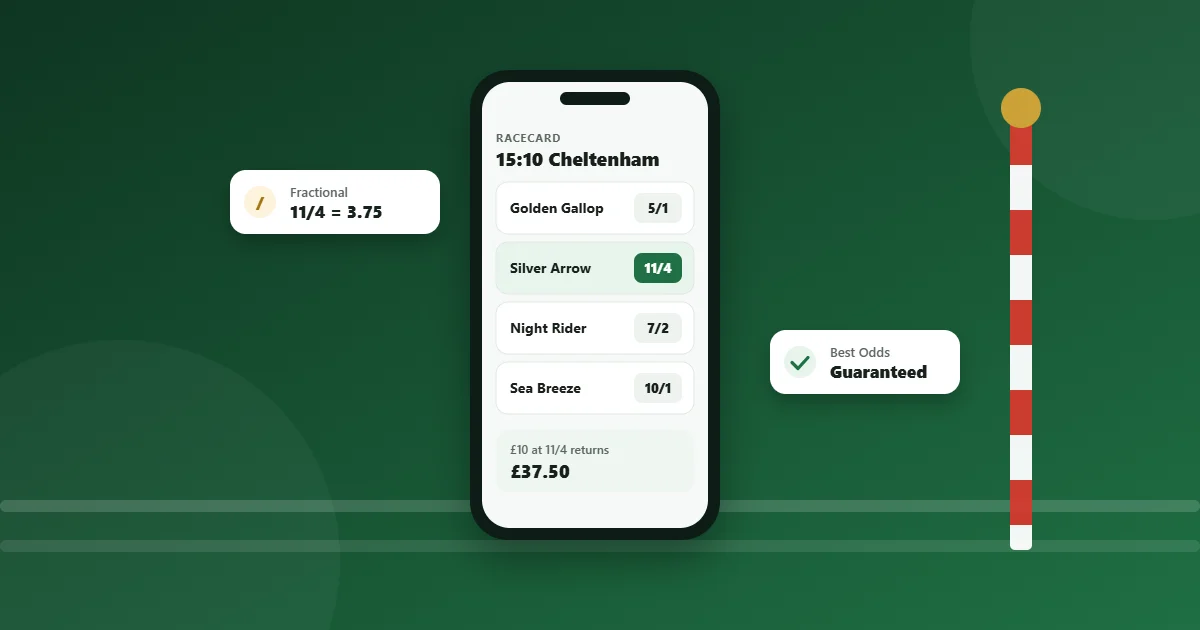
Fractional odds (5/2) show your profit compared with your stake. Decimal odds (3.50) show your total return for every £1, including the stake. To convert fractional to decimal, divide the first number by the second and add 1. To work out the implied chance, divide 100 by the decimal odds.
| Fractional | Decimal | Implied chance | £10 bet returns |
|---|---|---|---|
| 1/5 | 1.20 | 83.3% | £12.00 |
| 1/4 | 1.25 | 80.0% | £12.50 |
| 1/3 | 1.33 | 75.0% | £13.33 |
| 1/2 | 1.50 | 66.7% | £15.00 |
| 4/6 | 1.67 | 60.0% | £16.67 |
| 4/5 | 1.80 | 55.6% | £18.00 |
| Evens | 2.00 | 50.0% | £20.00 |
| 6/4 | 2.50 | 40.0% | £25.00 |
| 2/1 | 3.00 | 33.3% | £30.00 |
| 5/2 | 3.50 | 28.6% | £35.00 |
| 3/1 | 4.00 | 25.0% | £40.00 |
| 4/1 | 5.00 | 20.0% | £50.00 |
| 5/1 | 6.00 | 16.7% | £60.00 |
| 6/1 | 7.00 | 14.3% | £70.00 |
| 8/1 | 9.00 | 11.1% | £90.00 |
| 10/1 | 11.00 | 9.1% | £110.00 |
| 16/1 | 17.00 | 5.9% | £170.00 |
| 20/1 | 21.00 | 4.8% | £210.00 |
| 33/1 | 34.00 | 2.9% | £340.00 |
| 50/1 | 51.00 | 2.0% | £510.00 |
Odds calculator
Enter any fractional or decimal odds and your stake to see your returns, profit and the implied chance of winning.
Odds calculator
Returns: £35.00 · Profit: £25.00 · Decimal odds: 3.50 · Implied chance: 28.6%
What do odds-on, evens and odds-against mean?
- Odds-on (e.g. 4/6, 1/2): you win less than your stake. The horse is expected to win more often than not.
- Evens (1/1 or 2.00): you win the same as your stake. It’s a 50% chance.
- Odds-against (e.g. 5/1, 10/1): you win more than your stake. Most horses in most races are odds-against.
- Favourite: the horse with the shortest odds. Outsider: a horse at long odds, often 20/1 or bigger.
How are horse racing odds calculated?
Bookmakers start with their own assessment of each horse’s chance, based on form, the going, distance, the jockey and trainer, and the draw. They turn those chances into odds, then adjust them as bets come in.
The odds also include the bookmaker’s margin, called the overround. If you add up the implied chances of every horse in a race, the total comes to more than 100%, often 115–130% in a big field. The amount over 100% is the bookmaker’s built-in edge. This is why betting exchanges, where the margin is much smaller, can offer bigger prices.
What does SP mean in horse racing?
SP means starting price: the official odds for each horse at the moment the race starts. If you bet “at SP”, your bet is settled at those final odds. If you take a price earlier, you’re paid at that price instead, unless the bookmaker offers Best Odds Guaranteed and the SP is bigger. Read more in our guide to what SP means.
SP Betting Strategies
While betting at SP can be beneficial, there are strategies to consider:
1. Early Value: Sometimes, bookmakers offer better odds early on to attract bets. If you spot these early value odds, it might be worth taking them rather than waiting for the SP.
2. Market Movements: Keep an eye on market movements. If a lot of money is coming for a horse, its odds could shorten, so betting at SP might not be the best option.
3. Using Betting Apps: Using a reliable horse racing app can help you stay updated with real-time odds and make informed decisions. Check out our homepage for a list of the top horse racing apps.
When are horse racing odds published?
- Ante-post: for big races such as the Grand National and Cheltenham Festival, odds are available weeks or months ahead. Prices can be bigger, but you usually lose your stake if your horse doesn’t run.
- Early prices: for everyday UK and Irish racing, most bookmakers publish odds the evening before or on the morning of the race.
- On the day: prices keep moving with the betting until the off, when the starting price is returned.
Why do horse racing odds change?
- Weight of money: when lots of people back a horse, bookmakers shorten its price to limit their risk. Horses that aren’t backed drift out.
- Non-runners: when a horse is withdrawn, the others’ chances improve, so their prices shorten.
- The going: rain or a drying track can suit some horses more than others.
- Jockey bookings and stable news, such as a top jockey being booked or a horse reported in good form.
- Market moves on exchanges, which bookmakers watch closely and often follow.
What is a Rule 4 deduction?
A Rule 4 deduction reduces your winnings when a horse is withdrawn after you’ve taken a fixed price. Because the race is now easier to win, the bookmaker takes a set amount from each pound of your winnings, depending on how short the withdrawn horse’s price was. The shorter its price, the bigger the deduction. Bets placed at starting price aren’t affected, because the SP reflects the final field.
Each-way odds and Best Odds Guaranteed
An each-way bet pays a fraction of the win odds for the place part, usually 1/4 or 1/5 depending on the race. A 10/1 each-way bet at 1/5 odds pays 2/1 for a place. See our full guide to each-way betting.
Best Odds Guaranteed (BOG) means that if you take a price and the starting price is bigger, you’re paid at the SP. Many UK bookmakers offer BOG on UK and Irish racing, so it’s worth choosing an app that does. Compare them in our bookmaker app reviews.
Horse racing odds FAQs
How do you read horse racing odds?
Read fractional odds as “win this much for every amount staked”. At 5/2 you win £5 for every £2 you bet, so a £10 bet returns £35: £25 profit plus your £10 stake back.
What does 5/2 mean in horse racing?
5/2 means you win £5 for every £2 staked, the same as decimal odds of 3.50. A £10 bet at 5/2 returns £35 if the horse wins, and the bookmaker rates its chance at about 28.6%.
What does evens mean in betting?
Evens means odds of 1/1, or 2.00 in decimal. You win the same amount you stake, so a £10 bet at evens returns £20 if it wins. It implies a 50% chance.
What does odds-on mean?
Odds-on means the horse is priced shorter than evens, such as 4/6 or 1/2, so you win less than your stake. Odds-on horses are the ones the bookmakers expect to win more often than not.
What is the favourite in a horse race?
The favourite is the horse with the shortest odds in the race, meaning the betting market thinks it has the best chance of winning. If two or more horses share the shortest price, they are joint favourites.
What is SP in horse racing?
SP stands for starting price, the official odds of each horse when the race starts. If you take SP, your bet is settled at those final odds rather than a price you took earlier.
When are horse racing odds released?
Odds for big races are released weeks or months ahead as ante-post prices. For everyday UK and Irish racing, bookmakers usually publish early prices the evening before or on the morning of the race, and the market keeps moving until the off.
Why do horse racing odds change?
Odds change mainly because of the weight of money placed on each horse. Non-runners, going changes, jockey bookings and stable news also move prices, because bookmakers adjust odds to balance their book and reflect each horse’s new chance.
18+ | Gambling can be addictive. Please gamble responsibly. BeGambleAware.org