Horse Racing Bet Types Explained: Every UK Bet in One Guide
From a simple single to a 247-bet Goliath. How each bet works, how many bets it contains, what it costs and what you need to win, with worked examples.
All the bets at a glance
Tap a bet to jump to how it works.
| Bet | Selections | Bets | Pays out if… |
|---|---|---|---|
| Single (win) | 1 | 1 | Your horse wins |
| Each-way | 1 | 2 | Win part if it wins, place part if it places |
| Forecast | 2 in one race | 1 | They finish 1st and 2nd in the right order |
| Reverse forecast | 2 in one race | 2 | They finish 1st and 2nd in either order |
| Combination forecast | 3+ in one race | 6 (3 horses) | Any two finish 1st and 2nd |
| Tricast | 3 in one race | 1 | They finish 1st, 2nd and 3rd in order |
| Swinger | 2 in one race | 1 | Both finish in the first three |
| Double / Treble / Acca | 2 / 3 / 4+ | 1 | Every selection wins |
| Trixie | 3 | 4 | At least 2 win |
| Patent | 3 | 7 | At least 1 wins |
| Yankee | 4 | 11 | At least 2 win |
| Lucky 15 | 4 | 15 | At least 1 wins |
| Canadian (Super Yankee) | 5 | 26 | At least 2 win |
| Lucky 31 | 5 | 31 | At least 1 wins |
| Heinz | 6 | 57 | At least 2 win |
| Lucky 63 | 6 | 63 | At least 1 wins |
| Alphabet | 6 | 26 | Depends on which win |
| Super Heinz | 7 | 120 | At least 2 win |
| Goliath | 8 | 247 | At least 2 win |
| Placepot | 1+ per race, 6 races | Pool | A horse places in each of the six races |
| Jackpot | 1+ per race, 6 races | Pool | You pick the winner of all six races |
| Scoop6 | 1+ per race, 6 races | Pool | You pick the winner of six chosen races |
Single, place and each-way bets
The building blocks. Every other bet on this page is made from these.
Single (win) bet
A single, or win bet, is one stake on one horse to win. If it wins, you are paid at the odds you took (or the starting price). If it does not, you lose the stake. It is the simplest bet in racing and the easiest to keep track of.
Place bet
A place bet pays if your horse finishes in the places. You get a smaller price than for a win. With bookmakers, place-only betting is usually done through each-way or “without the favourite” markets. The Tote and the exchanges offer straight place pools and markets.
How many places are paid depends on the number of runners (see the each-way table below).
Each-way bet
An each-way bet is two bets of the same stake: one for the horse to win and one for it to place. So £5 each-way costs £10. If it wins, both parts pay. If it only places, the place part pays at a fraction of the odds.
| Race | Places paid | Place odds |
|---|---|---|
| 2–4 runners | Win only | – |
| 5–7 runners | 2 | 1/4 |
| 8+ runners | 3 | 1/5 |
| Handicap, 12–15 runners | 3 | 1/4 |
| Handicap, 16+ runners | 4 | 1/4 |
These are the standard UK terms. On big races many bookmakers pay extra places. Read our guide to extra places.
Forecasts, tricasts and swingers
Bets on where two or three horses finish in the same race.
Forecast (straight forecast)
Pick the horses to finish first and second in the correct order. It is one bet. The payout is calculated by the bookmaker’s forecast formula (the Computer Straight Forecast) or by the Tote pool, not by multiplying the odds.
Reverse forecast
Pick two horses to finish first and second in either order. It is two straight forecasts (A then B, and B then A), so £1 reverse forecast costs £2.
Combination forecast
Pick three or more horses, and any two of them to finish first and second in either order. It covers every pair in both orders: 3 horses is 6 bets, 4 horses is 12 bets and 5 horses is 20 bets.
Tricast
Pick the first, second and third in the correct order. A combination tricast covers every order: 3 horses is 6 bets and 4 horses is 24 bets. Tricasts are usually only available in handicaps with 8 or more runners.
Swinger
A swinger is a Tote pool bet: pick two horses to both finish in the first three, in any order. It is easier to land than a forecast, so it usually pays less.
Accumulators and multiples
Bets that link horses in different races. Returns from one leg roll on to the next.
Double, treble and accumulator
A double is two selections, a treble three, and four or more is an accumulator (a 4-fold, 5-fold and so on). It is one bet, and every selection must win. The winnings from the first leg become the stake on the next, so the odds multiply.
Each-way accumulators are two bets: a win acca and a place acca.
Conditional bets (“any to come”)
A conditional bet only goes on if an earlier bet wins. The most common is “any to come” (ATC), also called an “if cash” bet: if your first horse wins, part of the return is staked on a second horse. A stop-at-a-winner bet moves down a list of horses until one wins. These are mainly placed in betting shops, and few apps offer them.
Full-cover bets: Trixie to Goliath
Full-cover bets take every double, treble and accumulator from your selections. The “Lucky” bets also include the singles, so one winner gets a return.
Trixie
3 selections, 4 bets: 3 doubles and 1 treble. You need at least two winners for a return.
Patent
3 selections, 7 bets: 3 singles, 3 doubles and 1 treble. One winner gets a return.
Yankee
4 selections, 11 bets: 6 doubles, 4 trebles and a 4-fold. No singles, so you need at least two winners.
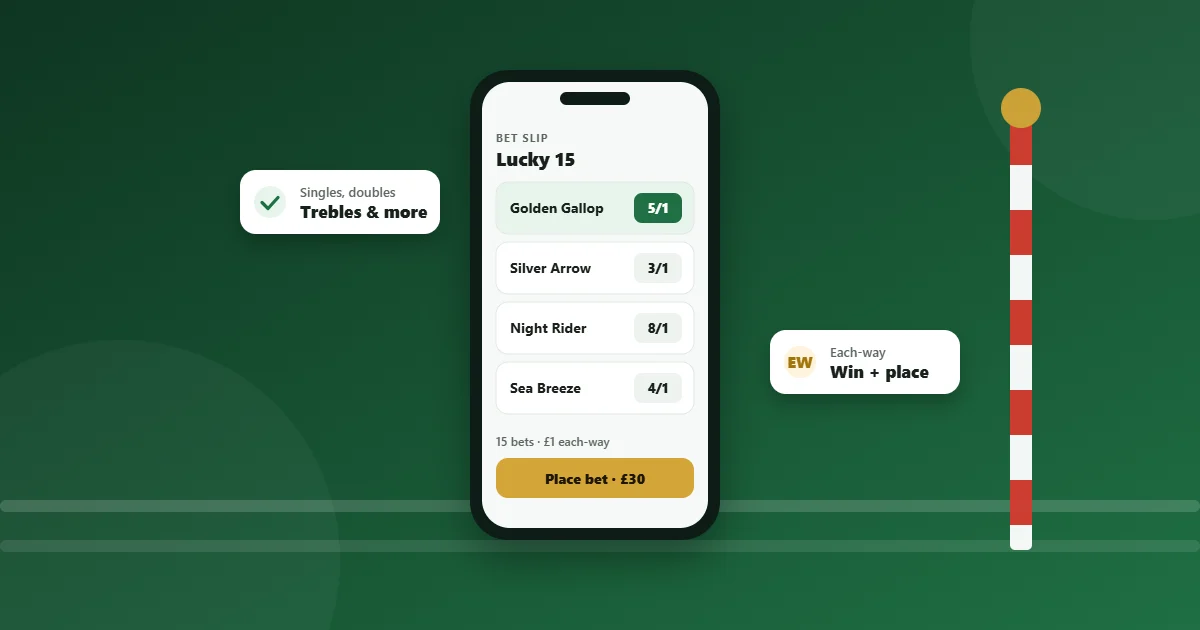
Lucky 15
4 selections, 15 bets: a Yankee plus the 4 singles. It is the most popular full-cover bet in UK racing. Many bookmakers add bonuses, such as double or treble odds if you have only one winner, and a bonus if all four win. Check each app’s terms. See how to place a Lucky 15 on the William Hill app or the 888sport app.
Canadian (Super Yankee)
5 selections, 26 bets: 10 doubles, 10 trebles, 5 four-folds and a 5-fold. You need two winners for a return.
Lucky 31
5 selections, 31 bets: a Canadian plus the 5 singles. One winner gets a return.
Heinz
6 selections, 57 bets, like the 57 varieties: 15 doubles, 20 trebles, 15 four-folds, 6 five-folds and a 6-fold. You need two winners.
Lucky 63
6 selections, 63 bets: a Heinz plus the 6 singles. One winner gets a return.
Alphabet
6 selections, 26 bets built from smaller bets: a Patent on selections 1–3, a Patent on selections 4–6, a Yankee on selections 2–5, and a 6-fold on all six. Order matters, so put your strongest picks in the Yankee.
Super Heinz
7 selections, 120 bets: every double up to the 7-fold. You need two winners.
Goliath
8 selections, 247 bets: every double up to the 8-fold. You need two winners, and a big return needs most of the eight to win.
Tote pool bets
With pool bets, all stakes go into a pool. The pool pays out to the winning tickets after a deduction. Read our guide to the Tote.
Placepot
Pick a horse to be placed in each of the first six races at a meeting. You can pick more than one horse per race. Each extra pick multiplies the number of lines, and the cost. The Quadpot works the same way over races 3 to 6. See our step-by-step placepot guide.
Jackpot
Pick the winner of six races at a set meeting. It is much harder than the Placepot, and if nobody wins the pool it can carry over to the next Jackpot, which makes it bigger.
Scoop6
The Tote’s big Saturday bet: pick the winners of six chosen races, usually across televised meetings. There is a win fund and a smaller place fund, and unwon pools can roll over. Check the Tote for the current rules.
Ante-post bets
Betting on a race well before the day.
Ante-post (future) bet
An ante-post bet is placed days, weeks or months before a race, before the final runners are known. Prices are often much bigger than on the day. The catch is that if your horse does not run, you usually lose your stake. Some bookmakers offer “non-runner no bet” on big races, so look out for it.
Which app takes these bets?
Every major UK app takes singles, each-way bets and multiples. Compare them by their real App Store and Google Play ratings.
Bet types FAQs
What is the most popular bet in horse racing?
The single win bet is the most common. Among multiple bets, the each-way and the Lucky 15 are the most popular with UK punters.
How many bets are in a Lucky 15?
15 bets from 4 selections: 4 singles, 6 doubles, 4 trebles and a 4-fold. A £1 Lucky 15 costs £15.
What is the difference between a Yankee and a Lucky 15?
A Yankee has 11 bets and no singles, so you need two winners for a return. A Lucky 15 adds the 4 singles, so one winner gets a return.
How does an each-way bet work?
It is two bets: one on the horse to win and one on it to place. The place part pays at a fraction of the odds, usually 1/4 or 1/5, depending on the number of runners and the type of race.
What is a Heinz bet?
A Heinz is 57 bets on 6 selections: 15 doubles, 20 trebles, 15 four-folds, 6 five-folds and a 6-fold.
What is the hardest bet to win in horse racing?
Pool bets such as the Jackpot and Scoop6, where you must pick six winners, are the hardest. That is why their pools can roll over and grow so large.
Related: horse racing odds explained · extra places · the Tote · cash out.
18+ only. Please gamble responsibly. BeGambleAware.org